
Additional information
| Weight | 1 lbs |
|---|---|
| Dimensions | 4 × 4 × 4 in |
| Height | |
| Zones | |
| Color | |
| Blooms | |
| Light |
Related Products
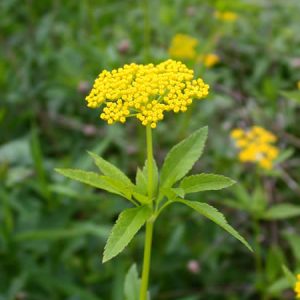
Zizia aurea – Golden Alexanders
Zizia aurea is one of those natives that every garden should have. It is fairly easy to grow and, although short-lived, will self-seed and persist in many sun/soil situations. Zizia is an important plant to a number of short-tongued insects that are able to easily reach the nectar in the small yellow flowers. Black Swallowtail caterpillars will feed on its leaves.
Golden Alexanders have a long bloom time, giving the garden/prairie some well-deserved early color for several weeks in late spring to early summer when many other plants have not yet flowered. Also called Golden Zizia, Golden Alexanders will tolerate a lot of shade but prefer full sun or light shade.
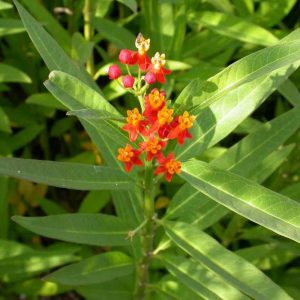
Asclepias curassavica – Tropical Milkweed
Tropical Milkweed, also known as Blood flower, is a tender evergreen perennial in the dogbane and milkweed family. It is native to South America, but has naturalized worldwide in many tropical and subtropical areas. It has a much longer flowering period than the perennial milkweeds that are winter hardy in Michigan. Showy red-orange flowers bloom late spring through late autumn except in USDA Zones 9-11 where it is winter hardy. Grows best in light, rich, evenly moist, well-drained soil in full sun. Will tolerate light shade and some soil dryness. Hummingbirds, butterflies and bees are attracted to the flowers. Monarch butterflies lay eggs on this plant and the resulting larvae (caterpillars) use the plant leaves as a food source. Flowers are followed by long, narrow seed pods (3-4” long) which split open when ripe releasing silky tailed seeds for dispersal by wind. Stems and leaves exude a milky sap when cut or bruised. Plants can be poisonous to livestock. Consider wearing gloves when working with these plants because the milky sap is poisonous if ingested and can be toxic to human skin.
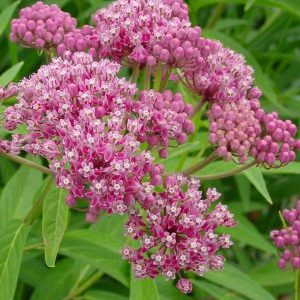
Asclepias incarnata – Swamp Milkweed
Swamp Milkweed occurs throughout most of the United States. It is a tall plant found in moist habitats such as wet meadows, floodplains, riverbanks, pond shores, stream banks, wet woods, swamps, and marshes, although it will also grow in drier areas such as prairies, fields, and roadsides. Swamp milkweed needs full sun or partial shade to flourish. Flowers are fragrant and very attractive to hummingbirds, butterflies and bees as a nectar source. Swamp milkweed is also an important food source for the larval stage of Monarch butterflies. The plants are deer resistant and heat tolerant. Also known as Rose Milkweed, Red Milkweed, and Marsh Milkweed.
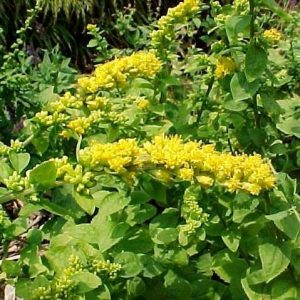
Solidago sphacelata – ‘Golden Fleece’ Dwarf Goldenrod
Another fantastic Mt. Cuba introduction. A stunning show of sprays of golden yellow flowers from mid-August through September. Semievergreen heart-shaped leaves. Truly an excellent groundcover and bee and butterfly charmer! Hairstreaks, sulphurs and skippers are particularly attracted to goldenrod. Monarchs visit it during their autumn migration.
Goldenrod Interesting Notes
Golden Fleece autumn goldenrod was discovered in 1985 as a spontaneous garden seedling in Eden, North Carolina. It was evaluated under diverse conditions at Mt. Cuba Center and determined to be a low-growing, compact form of the species suitable for use as an herbaceous perennial groundcover only reaching 18” tall. Multi-branched stems arise from basal rosettes of broadly rounded foliage and are covered with a profusion of golden-yellow floral spires from mid-September to October. It performs best in full sun with average moisture but is tolerant of a range of conditions from sunny and dry to partial shade. 'Golden Fleece' is hardy in zones 3-8. It won the Internationale Stauden-Union’s Award for an outstanding new plant in Switzerland in 1994. – Mt. Cuba Center
In many of the gardens I design, I use goldenrod to give late summer and fall gardens just the right autumnal color. Luckily for urban dwellers with limited gardening space, goldenrod also can be grown quite successfully in a container. Beautiful in the garden, goldenrod does double-duty as a long-lived cut flower. In Europe, where goldenrod has long been shown the appreciation it deserves, it is sold by the bunch, and gardening catalogs offer more cultivars than are available in the States.
Solidago sphacelata 'Golden Fleece' Growing and Maintenance Tips
Native to calcarous woodlands and rocky pastures from Virginia to Illinois south to Kentucky and Georgia. Prefers somewhat fertile, sandy, well-drained soils in full sun. Propagate by seed or division every 3-4 years. Cut back to encourage rebloom. Used in butterfly and wild gardens or as a groundcover or border perennial.
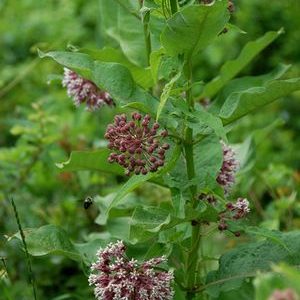
Asclepias syriaca – Common Milkweed
Asclepias syriaca Common Milkweed is the plant most people think of when they hear the word ‘milkweed’. This Michigan native occurs throughout most of the United States and thrives in almost any well drained soil and produces a profusion of fragrant mauve colored flowers in midsummer. The sweet scented flowers attract hummingbirds, butterflies, bees, and other pollinators and beneficial insects. Of all the milkweeds this is the easiest and fastest to establish, yet it is known to be invasive and must be used with care. This milkweed grows best in full sun and average to well-drained soil with no irrigation and will tolerate extreme conditions.
Available May 2017
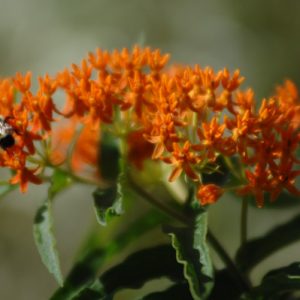
Asclepias tuberosa – Butterfly Weed Milkweed
The Perennial Plant Association is proud to announce Asclepias tuberosa as its 2017 Perennial Plant of the Year™.
Asclepias tuberosa-Butterfly Weed is one of the most well known wildflowers with its clusters of orange flowers. Native to Michigan and widely distributed throughout the United States, Butterfly Weed is a vigorous milkweed variety that produces clusters of flowers that bloom from early summer until frost. It is a nectar favorite for hummingbirds, bees, and butterflies as well as host plant for the Monarch butterfly. Like most Asclepias, this plant is happiest in well-drained soils. It is a great milkweed for a sunny location in a dry area. Mature plants in ideal locations can make as many as 20 stems at an average height of 2’. The vivid orange color, low mounded profile, and ability to attract and sustain butterflies make this plant a well-known favorite for all types of gardens. Butterfly Weed makes an excellent cut flower.
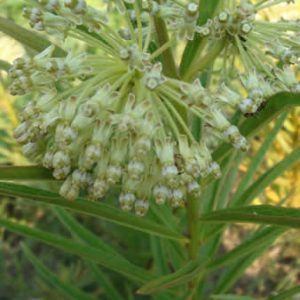
Asclepias hirtella – Tall Green Milkweed
Asclepias hirtella Tall Green Milkweed is a Michigan native although it is considered threatened in the state. Tall Green Milkweed is found throughout the Tallgrass Prairie region in open areas, usually in prairies or remnants of prairies and throughout the midwest. Though not as well known as other varieties of milkweed, Tall Green Milkweed distinguishes itself with abundant clusters of green-white flowers that attract many butterflies and bees.
Other Common Names in use include Green Milkweed.
Available May 2017