
Additional information
| Weight | 1 lbs |
|---|---|
| Dimensions | 4 × 4 × 4 in |
| Height | |
| Zones | |
| Color | |
| Blooms | |
| Light |
Related Products
Asclepias purpurascens – Purple Milkweed
DISTRIBUTION
USA: AR, CT, DC, DE, GA, IA, IL, IN, KS, KY, LA, MA, MD, MI, MN, MO, MS, NC, NE, NH, NJ, NY, OH, OK, PA, RI, SD, TN, TX, VA, WI, WV
Asclepias purpurascens – Purple Milkweed is a Michigan native milkweed and is native to most of the eastern United States though it is uncommon to rare in cultivated gardens. Similar to Ascelpeias syriaca (Common Milkweed) it is an excellent garden choice due to its non-invasive nature. It has a long bloom season and the fragrant, intense rosy pink flowers attract numerous insects and butterflies. Purple Milkweed is very tolerant of a wide variety of soils and light levels making it easy to grow. It will tolerate shade, but blooms better in the sun. It commonly occurs in dry to moist open woods, dry ridge tops, thickets, glades, prairie openings, stream banks and wet meadows.
All of our plants are grown without the use of harmful pesticides and are safe for developing larvae.
Grown in 4.5″ square pot.
Available mid-late June 2017
Asclepias tuberosa – Butterfly Weed Milkweed
The Perennial Plant Association is proud to announce Asclepias tuberosa as its 2017 Perennial Plant of the Year™.
Asclepias tuberosa-Butterfly Weed is one of the most well known wildflowers with its clusters of orange flowers. Native to Michigan and widely distributed throughout the United States, Butterfly Weed is a vigorous milkweed variety that produces clusters of flowers that bloom from early summer until frost. It is a nectar favorite for hummingbirds, bees, and butterflies as well as host plant for the Monarch butterfly. Like most Asclepias, this plant is happiest in well-drained soils. It is a great milkweed for a sunny location in a dry area. Mature plants in ideal locations can make as many as 20 stems at an average height of 2’. The vivid orange color, low mounded profile, and ability to attract and sustain butterflies make this plant a well-known favorite for all types of gardens. Butterfly Weed makes an excellent cut flower.
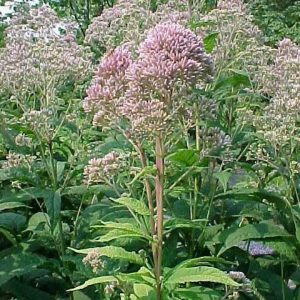
Eutrochium purpureum – Purple Joe Pye Weed
Easily grown in average, medium moisture soils in full sun to part shade. Prefers moist, fertile, humusy soils which do not dry out. Cut plants to the ground in late winter. Best propagated by stem cuttings. This species generally grows … Read More
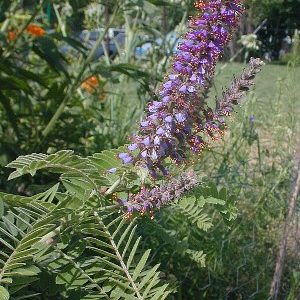
Amorpha canescens – Leadplant
Host Plant – Silver Spotted Skipper
This is a lovely, and very long lived shrub of the prairie. The deep purple flower spikes rise above the silver-gray foliage to create a striking bloom display in June. The very deep taproot allows this plant to be very drought tolerant. Butterflies are attracted.
Available May – Mid May
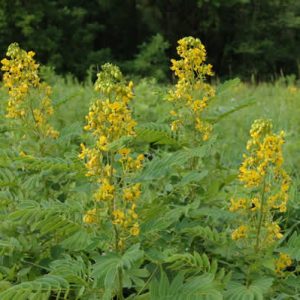
Senna hebecarpa – Wild Senna
Host Plant – Sulphur, Clouded Sulphur, Orange Sulphur
Wild Senna is a versatile plant that we think deserves more recognition as a great choice for garden or restoration projects. Its lovely, bright yellow flowers bloom July-August, attracting many bees and butterflies. Autumn brings beautiful leaf colors and the formation of long black pods with seeds favored by larger birds like wild turkeys. A horizontal root system provides strength against winds, allowing the plant’s stately (4-6′) beauty to be appreciated even after the storm. Some gardeners use this sun-loving plant to form a hedge.
It is virtually indistinguishable from its relative, Maryland Senna (Senna marilandica) until the two species have ripe seeds. The Wild Senna will readily open its pod and the seeds will fall out, whereas the Maryland Senna seed pods will stay tightly closed. Other than this, it is very hard to tell the two species apart.
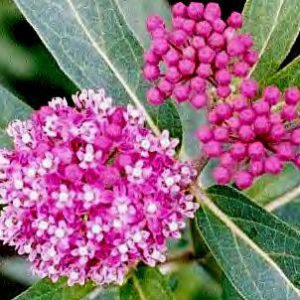
Asclepias incarnata – Cinderella Milkweed
‘Cinderella’ is a cultivar of native Asclepias incarnata (Swamp Milkweed) featuring pale pink, vanilla scented flower clusters. This milkweed occurs throughout most of the United States. It is a tall plant found in moist habitats such as wet meadows, floodplains, riverbanks, pond shores, stream banks, wet woods, swamps, and marshes, although it will also grow in drier areas such as prairies, fields, and roadsides. Swamp milkweed needs full sun or partial shade to flourish. Flowers are very attractive to butterflies and bees as a nectar source. Swamp milkweed is also an important food source for the larval stage of Monarch butterflies.The plants are deer resistant and heat tolerant.
Available – May 2017
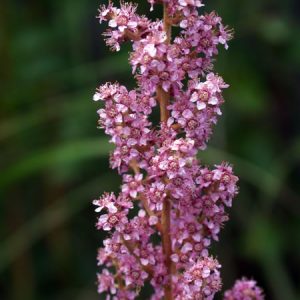
Spiraea tomentosa – Steeplebush
Pink spikes of flowers mid to late summer make Steeplebush a popular species. It grows best in moist acidic soils in full sun. Slow rhizomatous roots help this beautiful plant to spread.
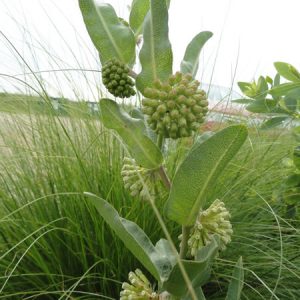
Asclepias viridiflora – Short Green Milkweed
Asclepias viridiflora Short Green Milkweed is a Michigan native milkweed. While somewhat rare it has an extensive range throughout the United States. The plant matures to 1-3′ in height making it a nice choice for borders. Short Green Milkweed blooms during early summer with blooms lasting about three weeks. Flowers are light green to green and as the plant matures the flowers begin to turn yellowish green or purplish green. It prefers full to partial sun and grows in a variety of soils but prefers dry-mesic to mesic. Habitats include openings in upland forests that are rocky or sandy; upland black soil prairies, sand prairies, gravel prairies, and hill prairies; barrens, limestone glades, and sand dunes; and abandoned fields.
The flowers attract bumblebees and butterflies. Also known as Green Milkweed, Green Comet Milkweed, Green Antelopehorn Milkweed, Green-Flowered Milkweed.