
Additional information
| Weight | 1 lbs |
|---|---|
| Dimensions | 4 × 4 × 4 in |
| Height | |
| Zones | |
| Color | |
| Blooms | |
| Light |
Related Products
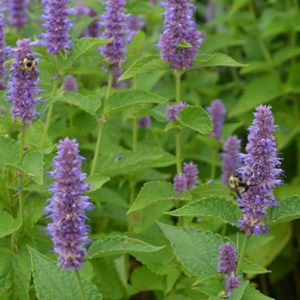
Agastache foeniculum – Lavender Hyssop
Anise Hyssop has very showy flowers, fragrant foliage and seems to be of little interest to deer. It self seeds readily and often blooms the first year. New seedlings are hardy and can be transplanted easily. It's a bee, hummingbird, and butterfly magnet and makes an excellent addition to herb gardens, borders, perennial gardens, and prairies. When the leaves of the Anise Hyssop are crushed they smell like licorice and have been used to make tea and cold remedies. Other common names in use: Lavender Hyssop or Blue Giant Hyssop
Available May to Mid May.
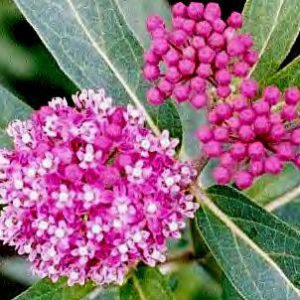
Asclepias incarnata – Cinderella Milkweed
‘Cinderella’ is a cultivar of native Asclepias incarnata (Swamp Milkweed) featuring pale pink, vanilla scented flower clusters. This milkweed occurs throughout most of the United States. It is a tall plant found in moist habitats such as wet meadows, floodplains, riverbanks, pond shores, stream banks, wet woods, swamps, and marshes, although it will also grow in drier areas such as prairies, fields, and roadsides. Swamp milkweed needs full sun or partial shade to flourish. Flowers are very attractive to butterflies and bees as a nectar source. Swamp milkweed is also an important food source for the larval stage of Monarch butterflies.The plants are deer resistant and heat tolerant.
Available – May 2017
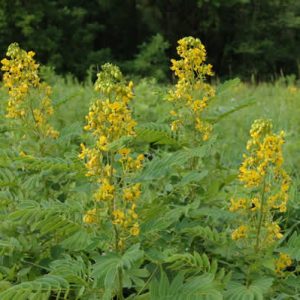
Senna hebecarpa – Wild Senna
Host Plant – Sulphur, Clouded Sulphur, Orange Sulphur
Wild Senna is a versatile plant that we think deserves more recognition as a great choice for garden or restoration projects. Its lovely, bright yellow flowers bloom July-August, attracting many bees and butterflies. Autumn brings beautiful leaf colors and the formation of long black pods with seeds favored by larger birds like wild turkeys. A horizontal root system provides strength against winds, allowing the plant’s stately (4-6′) beauty to be appreciated even after the storm. Some gardeners use this sun-loving plant to form a hedge.
It is virtually indistinguishable from its relative, Maryland Senna (Senna marilandica) until the two species have ripe seeds. The Wild Senna will readily open its pod and the seeds will fall out, whereas the Maryland Senna seed pods will stay tightly closed. Other than this, it is very hard to tell the two species apart.
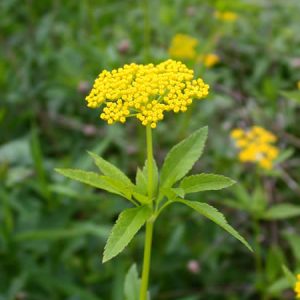
Zizia aurea – Golden Alexanders
Zizia aurea is one of those natives that every garden should have. It is fairly easy to grow and, although short-lived, will self-seed and persist in many sun/soil situations. Zizia is an important plant to a number of short-tongued insects that are able to easily reach the nectar in the small yellow flowers. Black Swallowtail caterpillars will feed on its leaves.
Golden Alexanders have a long bloom time, giving the garden/prairie some well-deserved early color for several weeks in late spring to early summer when many other plants have not yet flowered. Also called Golden Zizia, Golden Alexanders will tolerate a lot of shade but prefer full sun or light shade.
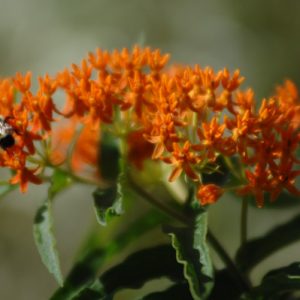
Asclepias tuberosa – Butterfly Weed Milkweed
The Perennial Plant Association is proud to announce Asclepias tuberosa as its 2017 Perennial Plant of the Year™.
Asclepias tuberosa-Butterfly Weed is one of the most well known wildflowers with its clusters of orange flowers. Native to Michigan and widely distributed throughout the United States, Butterfly Weed is a vigorous milkweed variety that produces clusters of flowers that bloom from early summer until frost. It is a nectar favorite for hummingbirds, bees, and butterflies as well as host plant for the Monarch butterfly. Like most Asclepias, this plant is happiest in well-drained soils. It is a great milkweed for a sunny location in a dry area. Mature plants in ideal locations can make as many as 20 stems at an average height of 2’. The vivid orange color, low mounded profile, and ability to attract and sustain butterflies make this plant a well-known favorite for all types of gardens. Butterfly Weed makes an excellent cut flower.
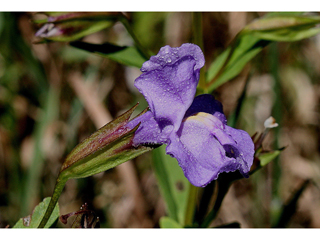
Mimulus ringens – Monkeyflower
This perennial plant is 1-3′ tall, branching occasionally to frequently. The light green stems are glabrous and bluntly 4-angled, but they are not conspicuously winged. The opposite leaves are up to 4″ long and 1″ across; they are light to medium green, lanceolate or elliptic-oblanceolate in shape, glabrous, and serrated to sparingly serrated along their margins. The leaves are sessile or they clasp the stems; petioles are absent. Leaf bases are round to slightly cordate, while their tips are slender and pointed. Individual flowers develop from the leaf axils of the middle to upper stems. These flowers are about 1″ long, and they have two-lipped corollas that are usually pale blue-violet (less often pink or white).
Available May – Mid May 2015
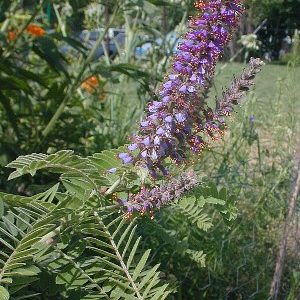
Amorpha canescens – Leadplant
Host Plant – Silver Spotted Skipper
This is a lovely, and very long lived shrub of the prairie. The deep purple flower spikes rise above the silver-gray foliage to create a striking bloom display in June. The very deep taproot allows this plant to be very drought tolerant. Butterflies are attracted.
Available May – Mid May
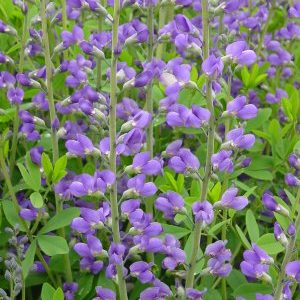
Baptisia australis – Blue False Indigo
Wild Indigo Duskywing / Eastern Tailed-Blue / Orange Sulphur / Clouded Sulphur / Frosted Elfin / Hoary Edge
Blue spikes of pea-shaped flowers resemble the tall racemes of lupines in May and early June. A slow to mature, but very rewarding native garden perennial. Found in open woods, river banks and sandy floodplains, New York to Nebraska to Georgia.