Description
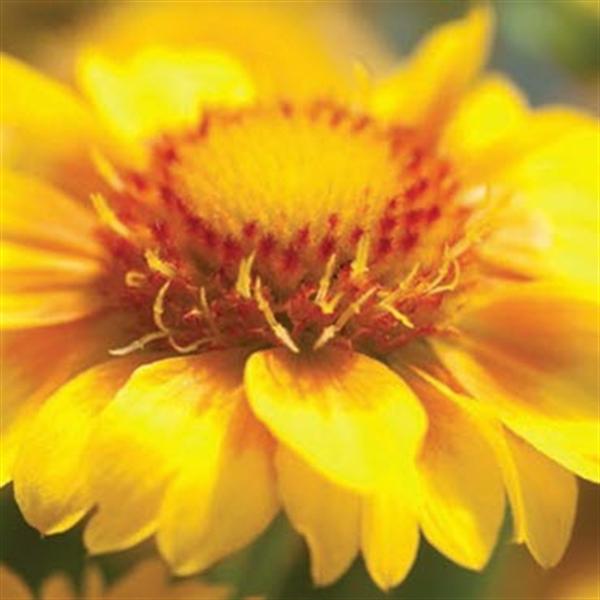
‘Arizona Apricot’ has yellow flowers with a deep apricot-orange center and is an AHS winner.

‘Arizona Apricot’ has yellow flowers with a deep apricot-orange center and is an AHS winner.
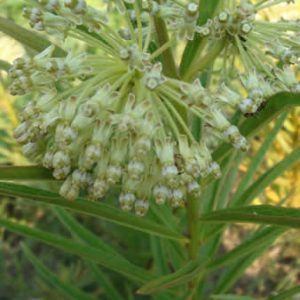
Asclepias hirtella Tall Green Milkweed is a Michigan native although it is considered threatened in the state. Tall Green Milkweed is found throughout the Tallgrass Prairie region in open areas, usually in prairies or remnants of prairies and throughout the midwest. Though not as well known as other varieties of milkweed, Tall Green Milkweed distinguishes itself with abundant clusters of green-white flowers that attract many butterflies and bees.
Other Common Names in use include Green Milkweed.
Available May 2017
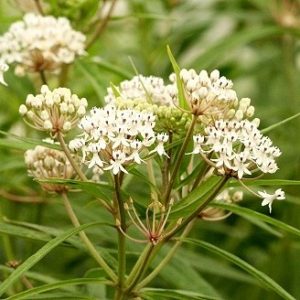
Aquatic Milkweed is a petite white milkweed suitable for wet soils. It survives in water and will grow in light-sandy and medium-loamy soils. Native to stream sides it is generally most common in lightly shaded woodlands near streams. This little milkweed is a great performer, being shade tolerant and flowering spring through autumn.
Available to ship mid-late June.
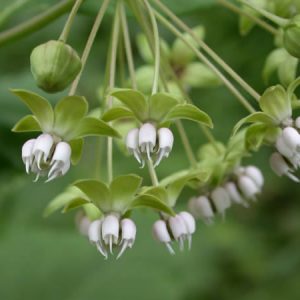
Poke Milkweed is native to Michigan and can also be found throughout the eastern portion of the United States and Canada. It is most often found at the edges of forests and upland woods and is one of the few milkweeds that prosper in shaded conditions. Tall and elegant with drooping flowers that are white with pink accents and extremely fragrant, this milkweed is a popular nectar source in addition to being a host plant for the Monarch butterfly. This is a non-aggressive milkweed and once established, plants are known to survive for decades.
Available – May 2017
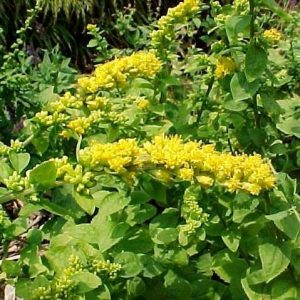
Another fantastic Mt. Cuba introduction. A stunning show of sprays of golden yellow flowers from mid-August through September. Semievergreen heart-shaped leaves. Truly an excellent groundcover and bee and butterfly charmer! Hairstreaks, sulphurs and skippers are particularly attracted to goldenrod. Monarchs visit it during their autumn migration.
Goldenrod Interesting Notes
Golden Fleece autumn goldenrod was discovered in 1985 as a spontaneous garden seedling in Eden, North Carolina. It was evaluated under diverse conditions at Mt. Cuba Center and determined to be a low-growing, compact form of the species suitable for use as an herbaceous perennial groundcover only reaching 18” tall. Multi-branched stems arise from basal rosettes of broadly rounded foliage and are covered with a profusion of golden-yellow floral spires from mid-September to October. It performs best in full sun with average moisture but is tolerant of a range of conditions from sunny and dry to partial shade. 'Golden Fleece' is hardy in zones 3-8. It won the Internationale Stauden-Union’s Award for an outstanding new plant in Switzerland in 1994. – Mt. Cuba Center
In many of the gardens I design, I use goldenrod to give late summer and fall gardens just the right autumnal color. Luckily for urban dwellers with limited gardening space, goldenrod also can be grown quite successfully in a container. Beautiful in the garden, goldenrod does double-duty as a long-lived cut flower. In Europe, where goldenrod has long been shown the appreciation it deserves, it is sold by the bunch, and gardening catalogs offer more cultivars than are available in the States.
Solidago sphacelata 'Golden Fleece' Growing and Maintenance Tips
Native to calcarous woodlands and rocky pastures from Virginia to Illinois south to Kentucky and Georgia. Prefers somewhat fertile, sandy, well-drained soils in full sun. Propagate by seed or division every 3-4 years. Cut back to encourage rebloom. Used in butterfly and wild gardens or as a groundcover or border perennial.
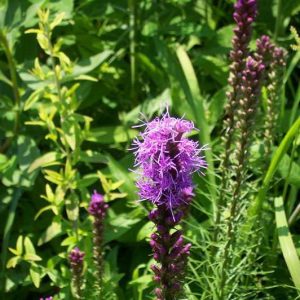
Easily grown in average, medium, well-drained soils in full sun. Somewhat tolerant of poor soils, but prefers moist, fertile ones and generally performs better in moist soils than most other species of Liatris. Intolerant of wet soils in winter. Tolerant of summer heat and humidity. May be grown from seed, but is slow to establish.
Blazing star (also commonly called dense blazing star or marsh blazing star) is a tall, upright, clump-forming perennial which is native to moist low grounds, meadows and marsh margins. In Missouri, it has only been found in Oregon County on the Arkansas border (Steyermark). It typically grows 2-4′ tall in cultivation, but can reach a height of 6′ in some parts of its native habitat. Features terminal spikes (6-12″ long) of sessile, rounded, fluffy, deep purple flower heads (each to 3/4″ across) appearing atop rigid, erect, leafy flower stalks. One or more stalks arise from a basal tuft of narrow, grass-like, medium green leaves (to 12″ long). Stem leaves gradually decrease in size toward the top. Blooms in summer. Liatris belongs to the aster family, with each flower head having only fluffy disk flowers (resembling “blazing stars”) and no ray flowers. The feathery flower heads of liatris give rise to another common name of gayfeather. See also L. spicata‘Kobold’ which is a popular compact cultivar that is less likely to need staking than the species.
Available May – Mid May 2017
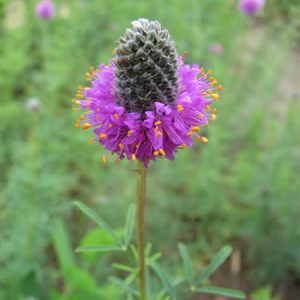
Host Plant – Sulphurs
Tiny rose-purple flowers in cylindrical, head-like masses at ends of upright wiry stems.
This is one of the most widespread of the perennial Prairie Clovers, identifiable by their cone-like flower heads. An excellent range species, with high protein content, Purple Prairie Clover decreases in abundance with overgrazing. A midwestern white-flowering species, White Prairie Clover has elongated flower heads and is only 2 (60 cm) tall. A white-flowering southeastern coastal plain species, D. carnea var. albida, has conspicuous green bracts within the heads.
USA: AR, CT, DC, DE, GA, IA, IL, IN, KS, KY, LA, MA, MD, MI, MN, MO, MS, NC, NE, NH, NJ, NY, OH, OK, PA, RI, SD, TN, TX, VA, WI, WV
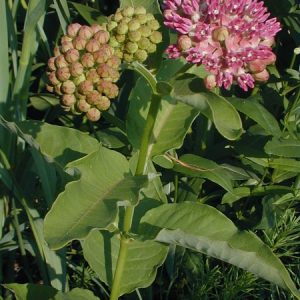
Asclepias purpurascens – Purple Milkweed is a Michigan native milkweed and is native to most of the eastern United States though it is uncommon to rare in cultivated gardens. Similar to Ascelpeias syriaca (Common Milkweed) it is an excellent garden choice due to its non-invasive nature. It has a long bloom season and the fragrant, intense rosy pink flowers attract numerous insects and butterflies. Purple Milkweed is very tolerant of a wide variety of soils and light levels making it easy to grow. It will tolerate shade, but blooms better in the sun. It commonly occurs in dry to moist open woods, dry ridge tops, thickets, glades, prairie openings, stream banks and wet meadows.
All of our plants are grown without the use of harmful pesticides and are safe for developing larvae.
Grown in 4.5″ square pot.
Available mid-late June 2017
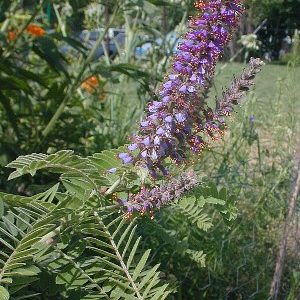
Host Plant – Silver Spotted Skipper
This is a lovely, and very long lived shrub of the prairie. The deep purple flower spikes rise above the silver-gray foliage to create a striking bloom display in June. The very deep taproot allows this plant to be very drought tolerant. Butterflies are attracted.
Available May – Mid May